
A slice isn't one fault. It's your grip, your lead wrist and your swing path working together to leave the face open. Here's how to check all three in five minutes, and why fixing them together is what finally makes it stick.
- Club path
- Ball flight
- Where you aimed
If you've fixed your slice before and it came back a week later, you're not imagining it. You probably did fix something. You just fixed one part of a three-part problem.
What a slice actually is
A slice curves because the clubface is open relative to the path the club is travelling on. Three things decide that:
- Your grip sets where the face starts.
- Your lead wrist decides where the face is at impact.
- Your swing path decides the direction the club is moving when it gets there.
Get all three right and the face meets the ball square to the path. Get any one wrong and the face stays open. But the real problem is how the three feed each other.
The chain that keeps a slice alive
- 1A weak gripYour hands are turned too far towards the target, so the face starts the swing open. To keep up, your lead wrist starts to cup.
- 2A cupped lead wristThe back of your wrist bends at the top, opening the face even further. Your brain sees the ball going right and tells you to swing left to save it.
- 3A flying elbow and an over-the-top pathYour trail elbow drifts away, your arms get thrown outside, and you cut across the ball. Open face, out-to-in path. Slice.
Fix the grip alone and the wrist still cups. Fix the wrist alone and the path still cuts across. Each fault keeps the others in place.
That's why one tip, one drill or one lesson so rarely sticks. The slice just finds another way out.
The 3-point slice check
Five minutes, a mirror or your phone, and an honest look. Do all three.
1Grip
Take your normal grip at address and look down at your lead hand.
2Lead wrist
Make a slow backswing, stop at the top, and look at the back of your lead wrist.
3Path
Stay at the top, side-on to the mirror, and look at your trail elbow.
Plenty of golfers who've sliced for years find more than one red answer. That's not bad news. It explains why nothing has stuck so far, and it tells you exactly what to work on.
What you can do today, for free
- Grip: before every shot, look down and count your knuckles. Turn both hands slightly away from the target until you see two or three.
- Lead wrist: make slow swings to the top in front of a mirror and hold a flat wrist for three seconds each time.
- Path: tuck a headcover under your trail armpit and make half swings, keeping it pinned until the club has passed the ball.
These work, slowly. The catch is that you're now holding three checks in your head, and at full speed, thoughts lose to habit. On the first tee, the old swing usually wins.
The fix that lasts is one your body can feel at full speed, for all three causes at once.
One trainer for each cause
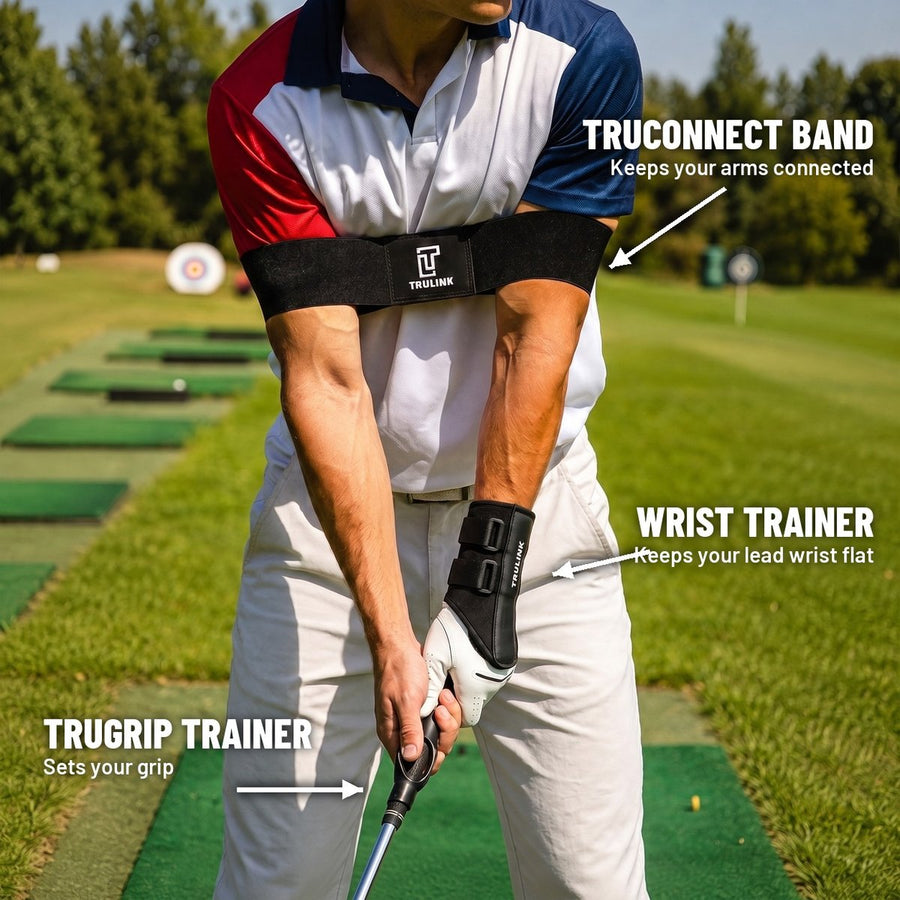
That's why we put together the Slice Fix Bundle. Each trainer handles one link in the chain, so you're not trying to remember three things mid-swing.
- Grip
- TruGrip Trainer. Clips onto any club in seconds. Your hands land in the same neutral hold every time, so the face starts square.
- Lead wrist
- Wrist Trainer. Straps onto your lead wrist and stops it cupping and flipping, so the face stays square through impact.
- Path
- TruConnect Band. Loops around both upper arms and keeps them connected to your turn, so your elbow can't fly and you can't come over the top.
How to use them
- 1Start with the Wrist Trainer. Make slow swings until a flat lead wrist feels normal.
- 2Add the TruGrip Trainer and hit 10 balls, letting your hands settle into the neutral hold.
- 3Add the TruConnect Band and build up from half swings to full swings.
- 4Practise 10 to 15 minutes, a few times a week, at the range, at home or before a round. Then take them off and play. The point is that the feel stays.
What golfers say
★★★★★
"Probably the best grip trainer on the market. Removed my slice."
Travis B.TruGrip Trainer
★★★★★
"Preventing cupping the wrist is what I needed in my game. Does it very well."
Charles A.Wrist Trainer
★★★★★
"At first, I was skeptical... but it really does what it claims. My elbow stays tucked, and my shots are much more consistent."
Jordan K.TruConnect Band
Slice Fix Bundle
£49.99 for all three
About £25 less than buying the trainers separately.
Get the Slice Fix BundleRight- and left-handed versions. Free shipping. 30-day money-back guarantee.
Only failed one of the three checks? Take the training aid quiz and we'll point you to the single trainer that fits.